
Marshall Release Date Meanings
A projected date is a calculation, not a record of a completed departure. The Kansas Department of Corrections locating information identifies the KASPER field as “Anticipated release date.” It reflects sentence structure and the credits known to KDOC when the record was updated. The date may be useful for planning and verification, yet it does not promise that a gate release will occur on that day.
An actual release is a custody movement that has already happened. KASPER may later show a movement and a status such as parole, postrelease supervision, or discharged. Those terms are not interchangeable. Parole and postrelease mean the person has left prison while remaining under KDOC control. Discharged means the sentence and its supervision obligation have ended. A transfer from Marshall County Jail to KDOC is also not a release into the community.
Which Marshall Custody System Applies
The first task is identifying the custodian. Marshall County Jail holds local detainees and people serving local jail terms. KDOC holds state prisoners. A person can also move to another jail, treatment placement, federal custody, or immigration custody. Each system describes only its own part of the custody chain.
| Situation | Best date source | What the result means |
|---|---|---|
| Marshall County pretrial custody | Court order and jail record | Bond or a judge’s order may permit release, but processing and other holds still matter. |
| Local jail sentence | Sentencing journal entry and jail computation | The county publishes no online formula or projected-date field. |
| Kansas prison sentence | KASPER and KDOC movement record | The anticipated date is projected; the later status shows what occurred. |
| Indeterminate state sentence | KASPER and Prisoner Review Board material | Eligibility permits consideration and does not guarantee parole. |
A current jail roster, where one exists, answers whether someone remains held. It is not a historical release source. Marshall County does not publish a public roster or projected-release calendar, so the official local route is the jail, court file, and a focused records request.
Search KASPER Release Dates
For a Kansas state prisoner, begin with the Kansas Adult Supervised Population Electronic Repository, commonly called KASPER. Search by name or KDOC identifier, compare identifying details, and open the matching record. Do not assume a similar name is the same person. The Marshall County connection could be the conviction county, former residence, supervision location, or the county jail from which a transfer began.
- Accept the KASPER search disclaimer and enter the strongest known identifiers.
- Compare the name, KDOC number, age or birth details, and other public identifiers before selecting a record.
- Locate “Anticipated release date,” then read the custody or supervision status and movement information around it.
- Check whether the record says incarcerated, parole, postrelease supervision, conditional release, or discharged.
- After the date passes, return to the record or request the existing movement entry from KDOC.
The official KASPER interface shows where the state search begins. The search controls and record fields can change, so use the live source rather than a copied result.
View the current KASPER search controls before comparing a Marshall County projected release date.
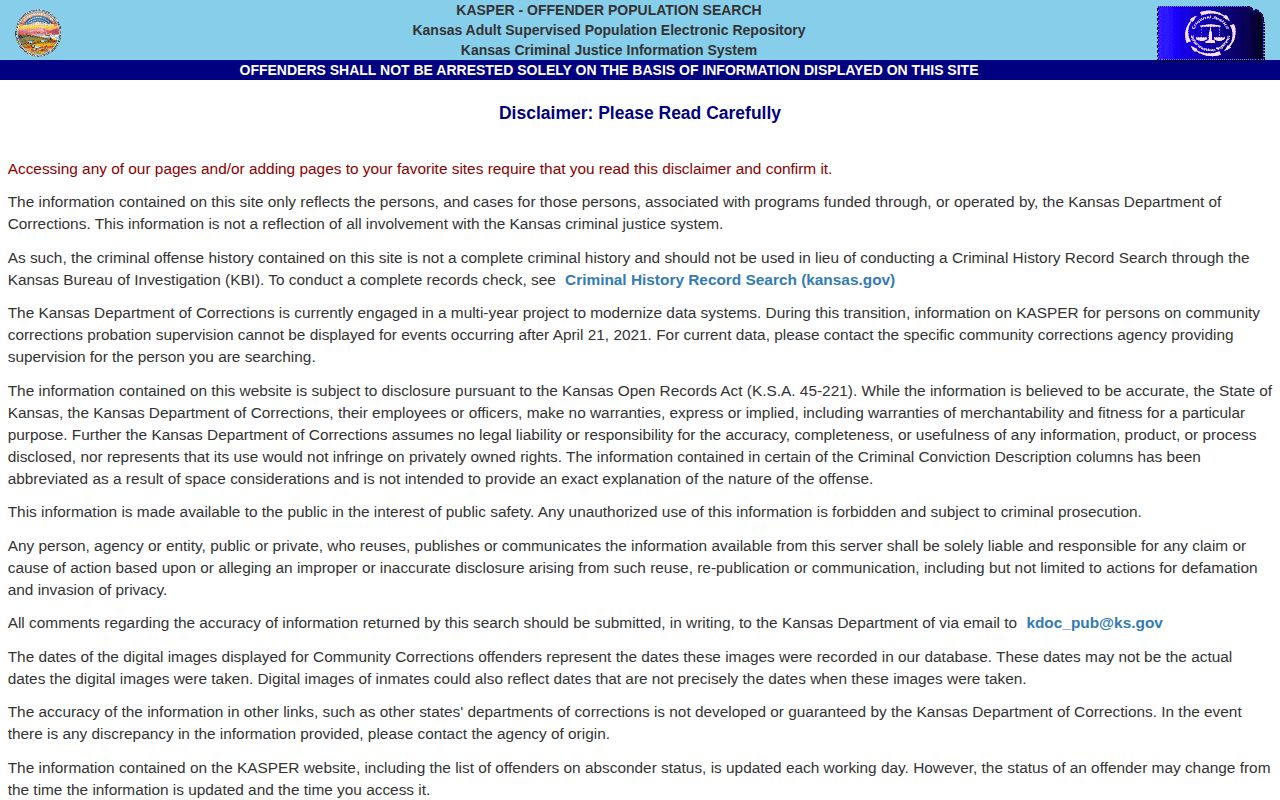
The captured interface illustrates the official state entry point. A selected person’s record, not the search screen alone, supplies the anticipated date and current status.
Kansas Good-Time Release Rules
For many determinate guideline sentences tied to crimes committed on or after July 1, 1993, K.S.A. 21-6821 generally permits maximum good time equal to 15 percent of the prison portion. That is the source of the common “about 85 percent” shorthand. It is not a rule for every Kansas prisoner. The same law provides a 20-percent maximum for listed lower-severity and offense-date categories, including specified drug and nondrug levels.
Eligible prisoners may also receive up to 120 days of program credit for successful completion of designated work. Offense restrictions and postrelease rules apply. Good time may be withheld or forfeited, so a sentence length by itself cannot produce a sound projected date. Jail credit, consecutive terms, amended sentences, new convictions, disciplinary action, and recalculation may all change the result.
- Good time
- Credit that may reduce time in prison when earned and retained under the governing law.
- Program credit
- A separate credit for qualifying completion of designated programming, subject to limits and exclusions.
- Postrelease supervision
- A required period of KDOC oversight after many determinate prison terms.
- Sentence discharge
- The point when incarceration and all supervision duties under that sentence have ended.
Leaving prison is therefore not the same as reaching discharge. Earned credit can move the prison-release calculation while a predetermined supervision term remains. KASPER may show the person in the community under supervision before it later shows “Discharged.”
The sentencing journal entry is the necessary starting document. It identifies the term imposed, whether terms run together or one after another, and jail credit found by the court. Even then, it is not a substitute for the KDOC computation. Credits depend on the controlling offense date, severity category, conduct, program eligibility, and later sentence events. A simple subtraction from the pronounced sentence can miss each of those inputs.
Marshall County court documents and KASPER also answer different questions. The journal entry states the legal sentence. KASPER reports the corrections calculation and present status. When those sources appear to conflict, preserve the record identifiers and ask KDOC to clarify the existing calculation rather than selecting whichever date appears sooner.
Marshall Parole Eligibility Dates
Old-law indeterminate sentences use different concepts. Under the credit framework in K.S.A. 22-3725, KDOC’s example of a 10-to-30-year term with all credits yields parole eligibility at five years and conditional release at fifteen years. That example explains the terms. It is not a calculator for another person’s sentence.
Parole eligibility is the first point when the Prisoner Review Board may consider discretionary release. Conditional release is a computed release from confinement that still carries supervision. The maximum sentence date marks the end of the full term. Special rules for life, off-grid, sex, and other sentences appear in K.S.A. 22-3717.
The Board may grant parole, continue the decision while seeking more information, or pass the person for later review. A hearing date or possible release month only establishes a stage in review. KASPER’s later movement and status are needed to see whether parole actually occurred.
Note: Conviction in Marshall County does not prove the person will return to Marshall County after state-prison release.
Why Marshall Release Dates Change
An anticipated release date can move for legal, sentence, or custody reasons. Some events change the computation. Others prevent a person from entering the community even when one sentence permits departure.
| Factor | Possible effect | Where to verify |
|---|---|---|
| Good-time or program credit | Earned, withheld, or forfeited credit changes the prison calculation. | KASPER and KDOC sentence record |
| Court action | An amended sentence, jail-credit ruling, or new case may alter dates. | Sentencing journal entry and docket |
| Consecutive sentence | One term may begin after another rather than run at the same time. | Court order and KDOC computation |
| Detainer or hold | Another agency may take custody instead of a community release. | Movement record and receiving agency |
| Parole decision | Eligibility may lead to parole, a continuance, or a later review date. | Prisoner Review Board and KASPER |
| Discipline or revocation | Credit loss or return to custody may produce a new calculation. | KDOC record and governing order |
A “released” entry is also custody-specific. It may mean release from one jail to another custodian. Ask for the release or movement type, receiving agency, and related legal authority when the destination is unclear.
Timing can also create an apparent conflict without a true error. An agency database may update after a court acts or after a physical movement is processed. A future date can remain visible while staff complete a revised calculation. Conversely, a court order can authorize release while a valid hold keeps the person in custody for another agency. Compare the source dates and identify which authority each record describes.
Marshall Jail Date Requests
Marshall County publishes no local good-time policy, weekend adjustment rule, release-day practice, or online calculation method. A sentencing order may state the term and jail credit, but it does not safely establish the precise exit time. For a local sentence, ask the Marshall County Jail at 107 South 13th Street, Marysville, Kansas 66508, 785-562-3141, for the existing computation or actual release entry.
If a documented response is needed, address a focused Kansas Open Records Act request to the Sheriff’s Office. The County Clerk can provide the county’s request form by phone at 785-562-5361 or email at swilson@mscoks.org. Ask for the custody movement entry, actual release date and time, release or transfer classification, booking number, legal authority, and receiving agency if public. Request electronic copies and an estimate before work starts.
K.S.A. 45-218 requires action on a request by the end of the third business day. Action can mean access, denial with a legal basis, or a detailed explanation of delay and the earliest available time. It is not a promise that every record will arrive within three days.
Confirm Marshall Actual Release
Use the final record from the system that held the person. For state custody, compare the KASPER anticipated date with the later movement and status. If a formal record is required, use the KDOC public-records request portal and ask for an existing release, discharge, or movement entry. Include the full name and KDOC number when known.
For county custody, call the jail and review the Marshall County District Court file for bond, dismissal, sentencing, probation, commitment, revocation, or discharge orders. The court explains legal authority. The jail record supplies the actual custody end or transfer. Neither should be substituted for the other.
Record the date each office checked its system and the exact status it reported. That small detail helps reconcile a same-day court order, jail movement, and delayed public database update.
A county-jail notification may also show a custody change, but Kansas VINE does not cover KDOC prison inmates. For a pending local change, the VINELink Check can add notification. Always distinguish release, transfer, and escape. Those events have very different meanings.
Note: A date that has passed without an updated result calls for agency verification, not a private recalculation.
Public Record Search
Sponsored Results