
Marshall County Parole Versus Probation
Parole follows release from prison under an indeterminate Kansas sentence. It is discretionary, which means the Kansas Prisoner Review Board may approve release after eligibility, but eligibility does not guarantee release. Probation is a court-ordered community sentence or supervision arrangement. A Marshall County probation case may be assigned to local Court Services or Community Corrections. Postrelease supervision is another state status. It follows many determinate prison sentences and does not depend on a discretionary parole grant.
The source is the first clue. KASPER, the Kansas Adult Supervised Population Electronic Repository, is the public starting point for KDOC parole and postrelease status. The Marshall County criminal docket and the local supervising agency are better for probation. A bond release is different again. It means the person left pretrial detention while the case remained open, sometimes with Court Services monitoring.
| Status | Who imposes it | Best verification route |
|---|---|---|
| Parole | Kansas Prisoner Review Board after prison eligibility | KASPER status, movement, and listed parole office |
| Postrelease supervision | Follows many determinate prison terms | KASPER and the KDOC supervising office |
| Probation | District court as a community disposition | Court order plus Court Services or Community Corrections |
| Bond supervision | Court while a criminal case is pending | Bond order, docket, and Court Services |
Leaving confinement and ending legal control are separate events. A KASPER status of “Parole” confirms supervised release from prison. “Discharged” means the KDOC sentence and supervision obligation have ended. Neither label should be inferred from a missing county-jail record.
- Parole
- Discretionary release from prison on an indeterminate sentence, followed by KDOC supervision.
- Probation
- A court-imposed community disposition that may avoid or follow confinement.
- Postrelease supervision
- Supervision that follows many determinate Kansas prison terms.
- Absconder
- A person reported out of compliance or whose location is unaccounted for while supervised.
- Discharge
- The end of the KDOC sentence and its supervision obligation.
Verify Marshall County Post-Release Supervision
Start with the sentence path, not a broad name search. A person convicted in Marshall County may be supervised elsewhere. Likewise, a person living locally may have been convicted in another county. KASPER allows searches by conviction county, parole location, facility, supervision type, name, aliases, and KDOC number. The KDOC number is the best match key when known.
- Read the Marshall County court docket and sentencing order. Determine whether the disposition was probation, a local jail term, or commitment to KDOC.
- For a KDOC case, open KASPER and accept the disclaimer. Search by KDOC number or use the name with birth and conviction details.
- Compare the case number, conviction county, photograph, movement history, status, and listed supervision office. Do not rely on a name alone.
- For local probation, contact the agency named in the court order. Court Services and Community Corrections handle different supervision levels.
- Ask the listed office for only publicly confirmable status. Use the KDOC number or court case number to reduce a mistaken match.
KASPER updates each working day, so a new release, revocation, or office change may not appear at once. It also may omit newer community-corrections probation events after April 21, 2021 because of a system modernization limit. Local verification is therefore part of the normal path, not merely a fallback. The Marshall County released-inmate search and records overview explains how the jail movement entry and court order fit with these supervision records.
Marshall County Parole Office Assignment
The official KDOC parole-office roster assigns Marshall County with Geary, Morris, and Riley Counties to the Junction City Parole Office. Use the office shown on an individual KASPER record when it differs. Supervision location can follow where the person lives or is assigned, rather than the county of conviction.
Junction City Parole Office
446 Grant Avenue
Junction City, KS 66441
785-238-1911
The office can clarify public supervision information when supplied with an accurate KDOC number. It should not be asked to guess from a common name. Probation questions belong with the court and the local agency stated in the order. Published research did not establish public walk-in hours for the parole office, so call before visiting.
The official KASPER interface illustrates the status and supervision fields used for a state case. View the KASPER search source before comparing the screen.
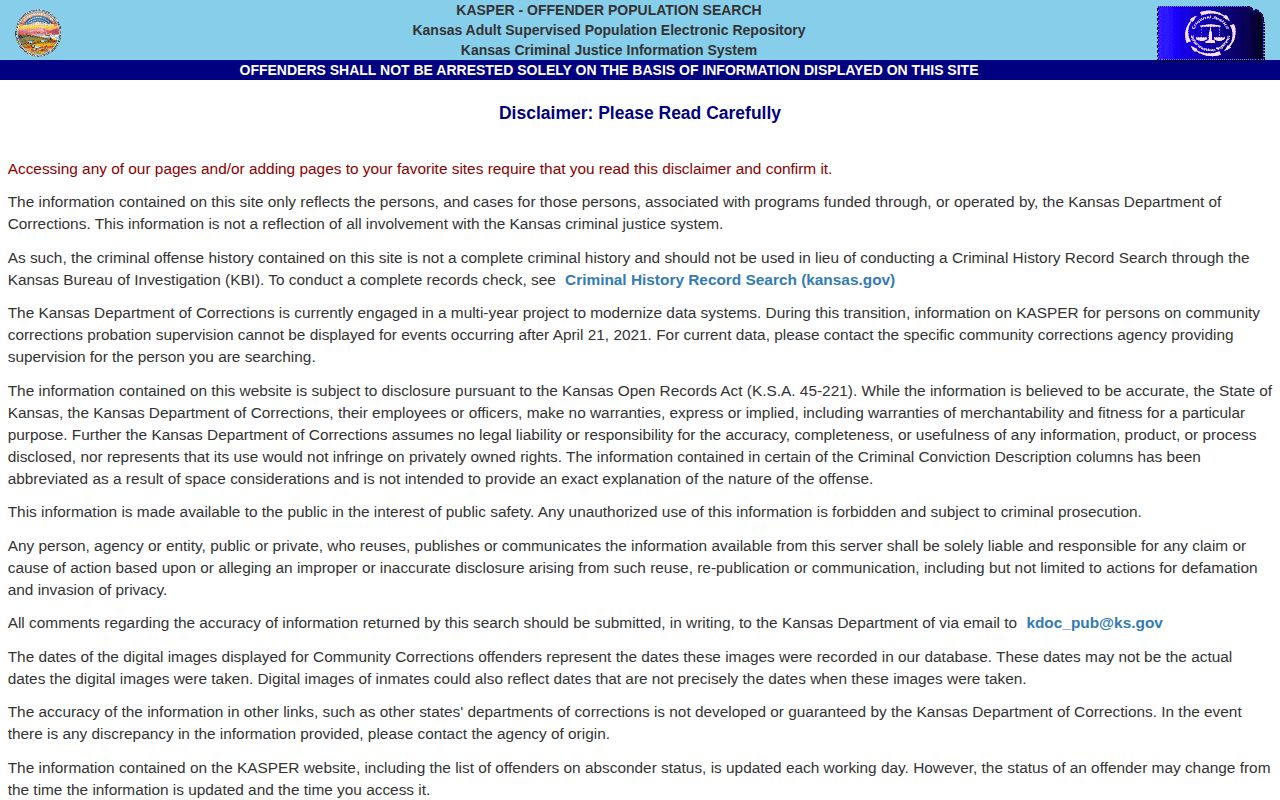
A matching record should be checked against the conviction county, case, movement, and listed office before treating the status as current.
Marshall County Absconder Status
KASPER provides a separate parole absconder search that can be filtered by last supervision location, including Kansas counties. An absconder status signals a supervision problem. It is not proof of a new arrest, current jail custody, or sentence discharge. A later warrant or revocation can create a new court or custody event, but the absconder result alone does not show that outcome.
Conditions vary by sentence and person. At a high level, supervision can require reporting, compliance with lawful directives, approved residence or travel, and completion of ordered programs. Public KDOC material may include non-sensitive conditions and violations that actually led to revocation. Private case details and protected information should not be inferred from a public status.
No official Marshall County-specific public warrant or absconder list was found. Check the court docket for a filed revocation or warrant event, then verify present custody with the correct jail or KDOC system. VINE covers adults in Kansas county jails, not KDOC parole status. A VINE alert must not be treated as a parole violation record.
Marshall County Probation Office Split
Marshall County divides local supervision between two offices. Court Services supervises adult and juvenile misdemeanor probation, some felony probation, some defendants released on bond, community service, and other court-directed matters. Community Corrections describes intensive supervision for adult felony offenders who otherwise could be incarcerated.
This split matters after release. A person reporting to Court Services after bond has not necessarily been convicted. A probationer under Community Corrections is not on parole merely because the supervision is intensive. Neither office is a statewide parole locator. The journal entry should identify the legal status, while the assigned local office can confirm current public details.
Use the case number when asking which office has the assignment. The same person can have more than one case, and the terms may differ. One matter may involve bond supervision while another has a probation order. A later prison commitment can move the relevant record into KDOC. Dates also matter. Compare the order date, jail movement date, and the start of supervision before concluding that one status replaced another.
The county’s Community Corrections source shows why local review remains necessary. Open the Marshall County Community Corrections page for the source context.
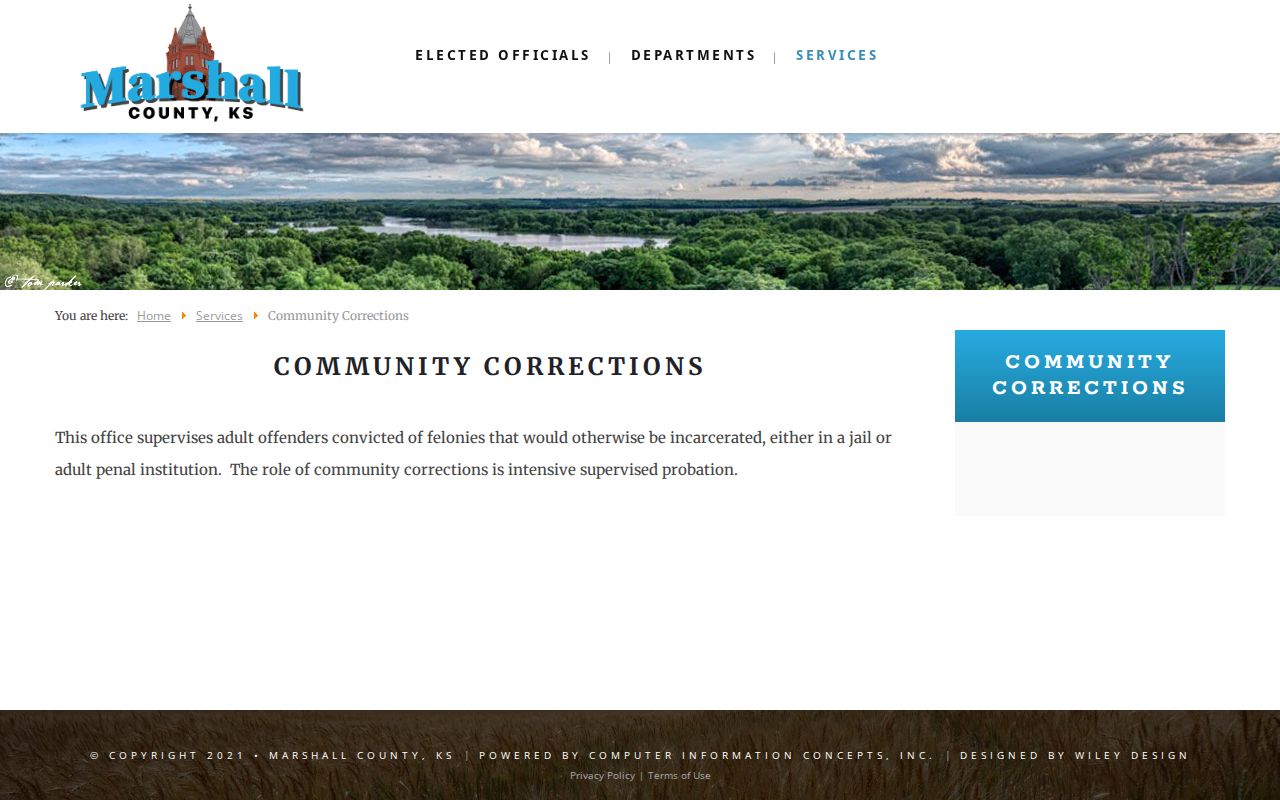
The page describes intensive felony probation, a distinct track from KDOC parole and postrelease supervision.
Note: A Marshall County conviction does not prove that the current supervising office is physically located in Marshall County.
Marshall County Parole Hearing Records
The Prisoner Review Board public-comment schedule is useful for applicable old-law parole cases. Sessions occur monthly, one month before the offender’s parole hearing. A list may show the KDOC number, county of conviction, case, offense, and a possible release month. It proves that review is scheduled, not that parole was granted.
The Board identifies three basic outcomes. “Parole” is approval subject to planning and conditions. “Continue” postpones the decision while more information, evaluation, deliberation, or votes are needed. “Pass” denies parole and sets later reconsideration. A separate public person-by-person decisions search was not found. KASPER’s later movement and supervision status are better evidence that release actually occurred.
K.S.A. 22-3717 governs eligibility and contains many offense-date and offense-type exceptions. Eligibility only permits consideration. It should never be converted into a promised release date. A formal decision record may be requested from KDOC or the Board under the Kansas Open Records Act, subject to redaction.
Marshall County Supervision Discharge
Supervision ends through an official discharge, not merely through release from a jail or prison. For a KDOC case, “Discharged” in KASPER means the state sentence and supervision obligation have ended. “Parole” or another active supervision status means legal control continues in the community. A transfer between offices also does not end supervision.
Local probation ends under the court’s order and record. The docket may show completion, discharge, revocation, or a later amended order. Confirm the exact wording with the clerk or supervising agency. An inactive-looking portal entry is not enough because remote document access and public status labels have limits.
A violation does not automatically identify the final result. The court may continue probation, change terms, impose a sanction, revoke probation, or enter another lawful order. For a KDOC case, revocation can return a person to confinement and change the movement record. Read the filed decision rather than assuming that an allegation ended supervision. If the public portal shows only a docket label, the courthouse record or a narrow records request may provide the filed order.
KDOC Victim Services has a separate notification route for eligible people concerned with offenders in KDOC facilities or under KDOC supervision. It does not cover county jail, probation, or non-KDOC Community Corrections cases. That boundary prevents a county custody alert from being mistaken for proof that state supervision ended.
Public Record Search
Sponsored Results